Roof replacement generates dense, concentrated weight that quickly damages residential driveways and exceeds municipal curbside limits. For projects in Buckhead or historic Virginia-Highland, an open-top container…
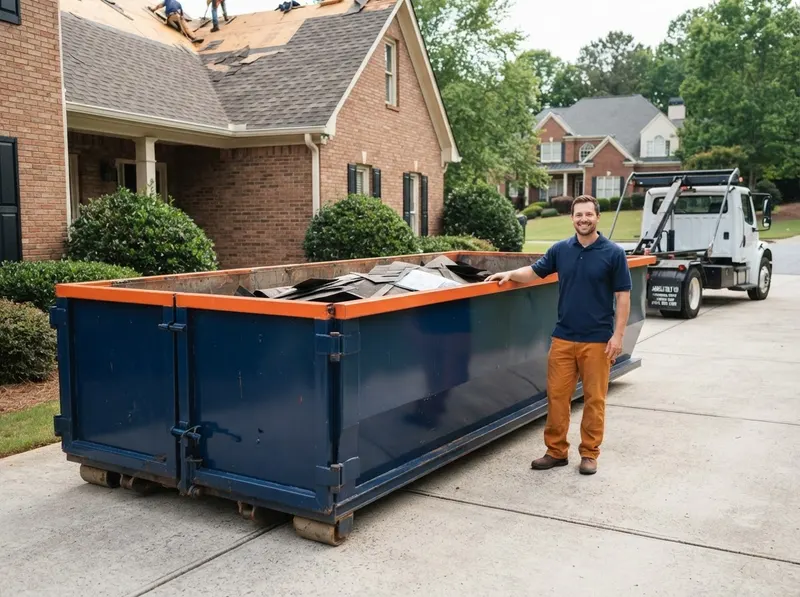
Roof replacement generates dense, concentrated weight that quickly damages residential driveways and exceeds municipal curbside limits. For projects in Buckhead or historic Virginia-Highland, an open-top container positioned precisely beneath the roofline prevents scattered nails and shingle fragments across lawns. Under standard building methods governed by the National Roofing Contractors Association, an average roofing square, covering 100 square feet, weighs between 220 to 250 pounds for standard 3-tab asphalt shingles and up to 400 pounds for architectural laminated shingles. When tearing off a 30-square roof with two previous layers, debris weight easily hits 15,000 to 20,000 pounds, requiring containers designed for concentrated structural loads.
Selecting the proper capacity prevents mid-job shutdowns and crew downtime. A 10-yard dumpster accommodates up to 25 to 30 squares of single-layer 3-tab shingles, making it suited for compact bungalows in Cabbagetown or Kirkwood. For larger residential re-roofs in Inman Park or Old Fourth Ward featuring multi-layer architectural shingles or water-damaged decking boards, a 20-yard or 30-yard roll-off provides the needed volumetric clearance. The operational trade-off centers on available staging footprint versus total weight: a 10-yard container fits narrow urban driveways without street encroachment, whereas a 30-yard or 40-yard container requires 22 feet of straight pull-in clearance. Every delivery follows our standard procedure: heavy roll-off steel wheels rest squarely on thick wood blocking rather than bare concrete or decorative pavers, honoring our commitment: On Time. On Boards. No Surprises.
Disposal must comply with municipal codes and environmental guidelines. Construction debris management aligns with environmental protocols set by the Georgia Environmental Protection Division, routing discarded materials away from illegal dumping grounds and into designated Fulton County construction and demolition landfills. Contractors adhering to the Occupational Safety and Health Administration jobsite fall and debris standards benefit from ground-level chute drop-ins, keeping work zones clear of tripping hazards. When placement requires staging on public streets in Midtown or Grant Park, residential permits may apply under City of Atlanta Department of Transportation street-use rules. Shingles can often be redirected to highway base projects through technical recycling specifications established by the National Asphalt Pavement Association and the Federal Highway Administration. For broader site sustainability standards recognized by the U.S. Green Building Council and waste reduction initiatives through the U.S. Environmental Protection Agency, separating tear-off shingles from mixed hazardous trash like wet solvent buckets or chemical adhesive cans remains mandatory under Earth911 commercial material sorting guidelines.
Every job gets a firm, written price after a free on-site visit.
For standards, safe disposal, and service guidance on DUMPSTER in Atlanta, GA, useful references include U.S. EPA, EPA, EPA, OSHA, Earth911, and Google Maps. General consumer and small-business resources are available from USA.gov, Better Business Bureau, FTC Consumer Advice, U.S. Small Business Administration, and Ready.gov.
Tell us about your roofing tear-off dumpster service job in Atlanta and we'll send a clear, written quote, usually the same day.
 SolidWay Haul Services